Modder creates custom ISA card, boosting Intel 8086 CPU speed by 2.5 times.
On the Intel 8086 and 8088, the MUL instruction is not implemented by dedicated hardware but relies on a shift and iterative addition algorithm controlled by microinstructions.
Fifty-year-old computer hardware may be sluggish by modern standards, but that hasn't stopped tech enthusiasts from finding ways to 'revive' it. Recently, a computer scientist known as Brad (@bradthx on X) unveiled a custom-made ISA accelerator card for PC systems running Intel 8086 and Intel 8088 processors. This project uses a TRW MPY12HJ hardware core chip to accelerate integer multiplication, resulting in a performance improvement of approximately 2.5 times compared to the original processor.
According to Brad, the idea stemmed from the limitations of early x86 CPUs in handling multiplication. On the Intel 8086 and 8088, the MUL instruction wasn't performed by dedicated hardware but relied on a shift algorithm and iterative addition controlled by microinstructions. This approach was similar to manually multiplying binary numbers on paper, making the calculation time-consuming and a performance bottleneck in many tasks.
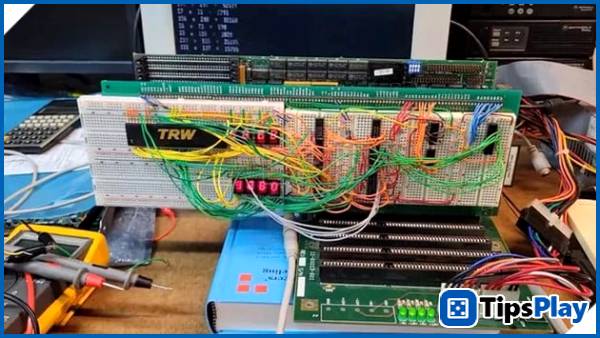
Brad's ISA card utilizes the TRW MPY12HJ chip – a 12x12 parallel multiplier that first appeared in the late 1970s and early 1980s. This chip was designed specifically for high-speed arithmetic operations and operated asynchronously, without requiring a clock speed. As a result, it could process multiplication significantly faster than the integrated micro-instruction algorithms in older Intel CPUs.
Notably, the TRW multiplier is fast enough to complete calculations between two consecutive bus cycles of the system, minimizing latency when communicating with the CPU. According to Brad, the new ISA card can accelerate MUL instructions by about 2.5 times compared to the integrated multiplier, without significant performance loss during operation.
Technically, this project could have been undertaken in the early days of personal computers. The TRW MPY12HJ chip already existed when the IBM PC Model 5150 was released in 1981 with an Intel 8088 CPU and an ISA slot. This means that, theoretically, engineers at the time could have developed a similar solution to speed up the system, but the cost and practical needs at the time likely prevented the idea from being widely implemented.
However, Brad's acceleration card isn't a 'comprehensive acceleration' solution for all classic software. According to him, only programs written or modified to utilize the hardware kernel can take advantage of the ISA card. Applications that are already pre-compiled will continue to use the CPU's default MUL instructions and won't receive any performance improvement.
This means the project primarily serves the purpose of research, testing, and preservation of classic technology, rather than practical upgrades for older PC systems. Nevertheless, it still demonstrates the creativity of the retro hardware enthusiast community and how they find new solutions from old technology.
In the context of increasingly powerful modern computers, projects like the ISA card for the Intel 8086 remind us that the history of technology still holds much untapped potential. More than just nostalgia, such experiments help us better understand how early computer architectures worked and how to optimize them with innovative ideas.
Update 06 April 2026
Jessica Tanner
Jessica Tanner is a Technical Analyst who serves as a crucial link between an organization's business needs and its information technology (IT) systems. She specializes in evaluating, designing, implementing, and maintaining software, hardware, and network systems to optimize business processes.