NTT develops multi-core fiber optic cable (MCF), increasing Internet transmission capacity fourfold.
In addition to MCF cables, NTT also develops supporting technical equipment to enable the technology to be deployed in practice.
Japanese telecommunications giant Nippon Telegraph and Telephone (NTT) has announced its Multi-Core Fiber (MCF) technology, which allows for a fourfold increase in data transmission capacity compared to traditional fiber optic cables without changing the cable diameter. This is considered a significant step in upgrading global internet infrastructure as data demand continues to grow rapidly.
In the context of rapidly developing 5G networks, artificial intelligence, and cloud computing, undersea fiber optic cables are having to handle enormous amounts of data. Building new cables is often expensive, time-consuming, and requires significant resources, forcing telecommunications companies to seek solutions to upgrade the performance of existing systems. NTT's MCF technology was developed to address precisely this problem.
Increase capacity without changing infrastructure.
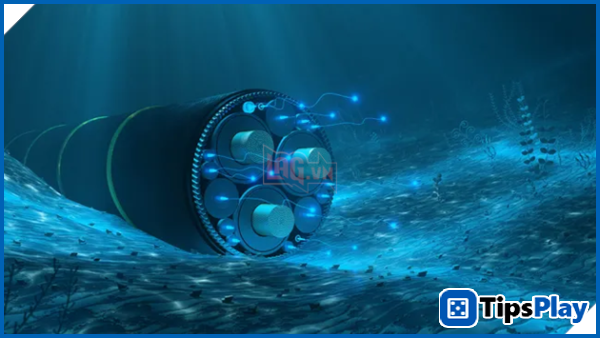
The key feature of MCF is the integration of four independent optical cores within a single cable, instead of just one core like traditional cables. Thanks to spatial multiplexing technology, a single cable can simultaneously transmit four separate optical signal streams, significantly increasing data transmission capacity.
NTT stated that maintaining the same cable cross-section and diameter is key because it ensures the new technology is compatible with existing infrastructure such as submarine cable-laying vessels, ground-based connection systems, and terminal equipment. This allows network operators to upgrade transmission capacity without replacing the entire system, saving costs and shortening deployment time.
Currently, many undersea fiber optic cables use around 48 optical fibers per line. With MCF technology, this number can increase to the equivalent of 192 transmission cores, opening up the possibility of transmitting much larger amounts of data within the same cable. This is especially important as global data traffic continues to surge due to the demand for streaming, AI, data centers, and cloud services.
Underwater fiber optic cables are becoming a strategic infrastructure.
The demand for constructing and upgrading undersea fiber optic cables is rapidly increasing globally as the Internet becomes the foundation of all digital economic activity. Despite facing risks such as cable breaks, natural disasters, or geopolitical tensions, technology corporations continue to invest heavily in this infrastructure.
Notably, Meta is reportedly planning to build a new submarine cable route to avoid areas with high geopolitical risk such as Northern Europe, the Middle East, and the Malacca Strait, in order to ensure the stability of global connectivity.
Expected to be implemented in 2029.
According to NTT, multi-core fiber optic cable (MCF) technology is expected to be commercially deployed in 2029. Once implemented, this technology could significantly increase data transmission capacity, reduce infrastructure upgrade costs, and shorten the deployment time for new cable routes.
In the context of rapidly increasing global data traffic, MCF is seen as a crucial step in building next-generation Internet infrastructure, helping network operators optimize costs, improve performance, and ensure future scalability.
Update 30 March 2026
Kareem Winters
Kareem Winters is an AI integration expert, a strategic process of embedding artificial intelligence technologies—such as machine learning (ML), natural language processing (NLP), and computer vision—directly into an organization's existing systems, applications, and workflows.