NVIDIA brings the power of AI to you.
The Power of AI – In late 2022, after OpenAI launched its first commercial version of ChatGPT, the entire tech world became abuzz with the AI ??'game,' with a series of AI-powered applications launched in the following years to provide solutions to various life problems, significantly changing the way users work and entertain themselves worldwide.
As one of the pioneering investors in AI technology, NVIDIA has provided users with the simplest way to enhance the use of AI power for work and entertainment.
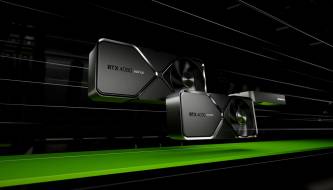
These are the GeForce RTX graphics cards, most recently the GeForce RTX 40 Series, with powerful processing cores, equipped in advanced work and gaming laptops currently on the market.
This article will introduce readers to some of the most basic concepts of AI technology, as well as how GeForce RTX graphics cards can help you accelerate these applications.
What is AI? Why can GeForce RTX graphics cards handle demanding AI tasks?
Although the AI ??trend has only emerged in recent years, in reality, AI is a rather old concept, most commonly applied in the world of gaming, especially in how computer-controlled characters can react to player actions.
Traditionally, AI is understood as a series of pre-programmed scenarios that allow users to achieve output results corresponding to input data, following a basic if-then structure. The complexity of the 'scenarios' created by programmers will enable AI to react to input data in a more diverse way, even becoming as 'human' as the virtual assistants we used to use.
The AI ??revolution only truly began when people used machine learning functions to create 'super-complex' algorithms/scenarios based on existing data (learned data) by fine-tuning the 'weights' so that the output data matched the expected results from the input data. Naturally, this resulted in algorithms possessing hundreds of millions (as in the first-generation ChatGPT language model), or even billions, of parameters to process in modern AI models.
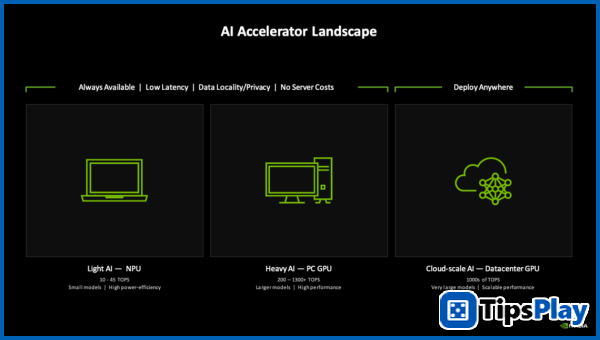
With such a complex, branching algorithm/scenario, CPU models are typically not used to solve the problems. Traditional CPUs, while powerful enough to lift a millstone, are too small and fragmented to handle the sheer volume of AI processing simultaneously, causing data to queue up and wait for processing. In simpler terms, CPUs lack the AI ??power to handle these tasks quickly.
With NVIDIA graphics cards, things are completely different!
Each GeForce RTX graphics card possesses thousands of CUDA cores. Although each core is significantly less powerful than a single CPU core, they are like thousands of ants carrying sesame seeds, and this method is obviously far more efficient than using a traditional CPU.
This is why recently released CPUs have had to add NPU (Neural Processing Units) to bring AI power to the CPU, but these are just "extras" with relatively little power, approximately 50 TOPS (Tera Operations per Second) compared to the thousands of TOPS on high-end NVIDIA graphics cards, barely enough to handle a few simple AI tasks.
Therefore, NVIDIA GeForce RTX graphics cards are in fact still the best choice for handling AI tasks today.
Applications of 'AI power'
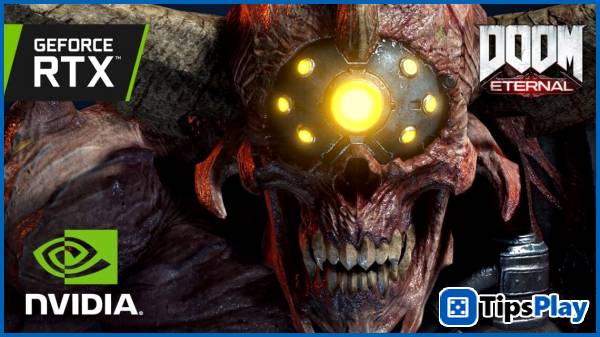
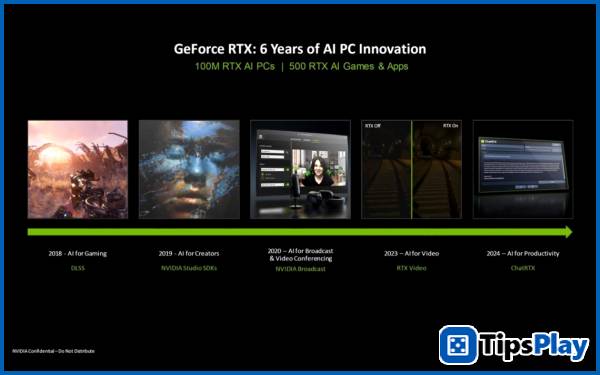
Leveraging the power of AI , NVIDIA and other leading AI companies have brought many technological advancements to users, with gamers being the first to benefit from DLSS (Deep Learning Super Sampling) technology.
With the introduction of advanced Ray Tracing rendering technology in 2018, even today's most powerful machines struggle to handle demanding games, such as Cyberpunk 2077 with its Phantom Liberty expansion featuring upgraded Ray Tracing rendering technology, capable of handling even the most powerful NVIDIA RTX 4090 graphics cards currently on the market.
That's why, even before the 'AI craze' exploded, NVIDIA had already launched a technology to upscale resolution using DLSS machine learning to reduce the load on the GPU.
Even NVIDIA itself has applied this technology to 'venture' into the ultra-high-end gaming realm with the game DOOM Eternal on 8K resolution screens, running smoothly – the highest resolution on the market today, up to 64 times higher than traditional 1080p resolution.
In addition, NVIDIA has also developed applications to support users in creating content based on the power of AI, such as NVIDIA Broadcast.
This application allows you to use only your computer's webcam and microphone for live streaming or online meetings without needing specialized equipment.
AI can recognize your face to keep you in the center of the frame even as you move around during your broadcast to present your ideas, replace the background behind you with the scenery you want, or AI can recognize your voice to filter out background noise, ensuring your voice remains clear even during online meetings in noisy environments.
Recently, NVIDIA also launched the ChatRTX language model, allowing users to train on-site with their own data. Leveraging Retrieval Augmentation (RAG), TensorRT-LLM, and RTX acceleration capabilities, you can query a custom chatbot to quickly receive contextually relevant answers.
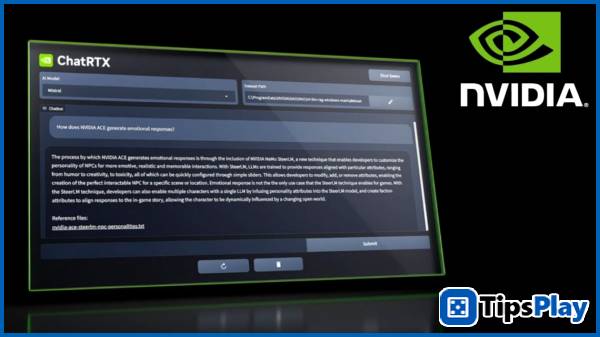
Because it operates entirely on your device, this language model works faster than cloud-based services, but in return, you'll need significant AI power for the machine to learn and respond quickly to your commands, from searching for movies and images, to searching for sections in documents, or fully recognizing the language on your device to enhance security.
Additionally, NVIDIA has also developed the RTX AI ecosystem with a large number of high-quality open-source models for application developers to leverage, but most are pre-trained for general purposes and built to run in data centers.
Now, developers can build AI-powered software applications for RTX PCs through scalable environments, hardware and software optimization, and new APIs.
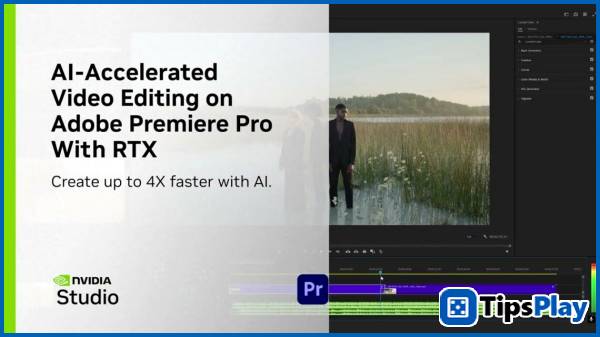
Not limited to NVIDIA-developed AI applications, GeForce RTX graphics cards significantly accelerate most AI tasks currently on the market, bringing AI power to professional users, enhancing work quality, and increasing productivity.
One indispensable application for many content creators is Stable Diffusion, which allows users to draw or create conceptual videos, enabling more in-depth manipulation. It now operates up to 60% faster than the previous generation and is up to 7 times faster than running on Macbook Pro models using the Apple Silicon M3 Max processor.
Leading app developers in the market today, such as Adobe and Epic Games with Unreal Engine 5, are constantly releasing updates that integrate AI features into their applications, giving users more ways to create content.
Conclusion
Overall, in the current boom of AI models and technologies, you need to understand the power of AI to keep up with current and future trends.
It can be said that owning a laptop or PC system with NVIDIA GeForce RTX graphics is the best preparation for professional users for a colorful AI future.
Join NVIDIA's RTX AI PC Day event!
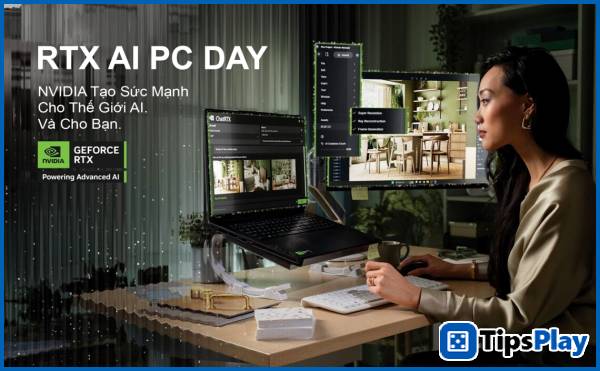
NVIDIA Vietnam is organizing RTX AI PC Day in Ho Chi Minh City on October 26, 2024. At this event, NVIDIA, along with brands such as ACER, ASUS, MSI, COLORFUL, HP, GIGABYTE, INNO3D, PNY, and ZOTAC, will showcase live demos of AI applications on the latest PC models.
tipsplay.net will bring you the latest news in the coming time.
Update 19 March 2026
Lesley Montoya
Lesley Montoya is an expert in game development, as well as a collaborative, multi-stage process for creating video games, including planning, design, programming, visuals, and testing.