What upgrades does AMD FSR 4 offer? ? Technology
AMD FSR 4 – Remember 10 years ago, when NVIDIA GeForce GTX 980 Ti graphics cards were released, they were advertised as a breakthrough allowing gamers to enjoy games at resolutions up to 4K, but even today, that is still relatively "too much" for most modern graphics cards.
Because a host of next-generation rendering technologies such as Ray Tracing and ultra-high-resolution textures place a heavy burden not only on next-generation graphics processors but also on CPUs, even the most powerful graphics cards struggle to handle 4K resolution, especially with extremely demanding games like Black Myth: Wukong.
Therefore, from a very early stage, both NVIDIA and AMD developed gaming support tools such as DLSS (Deep Learning Super Sampling) and AMD FidelityFX Super Resolution (FSR) to reduce the load on the graphics card.
Most recently, AMD released the fourth update to its FSR technology, called AMD FSR 4 .
So what upgrades does this technology offer compared to previous generations?
AMD FSR 4 – Major upgrades over the previous version
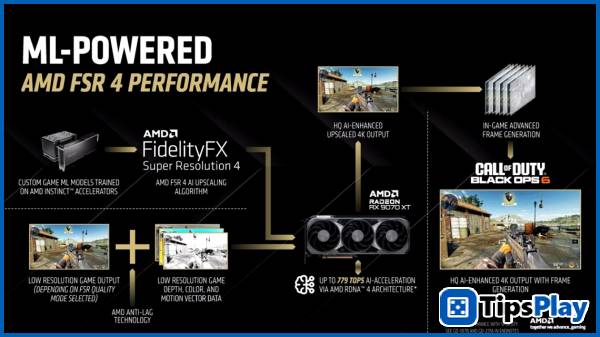
Unlike FSR 3.1, which relied on traditional algorithms, AMD FSR 4 applies machine learning and artificial intelligence to upscale images.
Thanks to specialized neural networks, AMD FSR 4 delivers sharper images, reduces ghosting, and retains better detail in fast-moving scenes. This is especially evident in graphically intensive games or those running on Unreal Engine 5, such as Clair Obscur: Expedition 33, where fine details like hair strands and light reflections on metal are reproduced with near-perfect accuracy.
Beyond just image quality, AMD FSR 4 also integrates automatic updates via the Adrenaline driver, ensuring gamers always have access to the optimal version without having to wait for individual game patches. This is an advantage that FSR 3.1 lacks.
Compared to FSR 3.1, AMD FSR 4 clearly demonstrates significant advancements in many aspects. In terms of display capabilities, while FSR 3.1 significantly reduced ghosting compared to FSR 2 but still showed limitations in high-speed scenes, FSR 4.0 has more thoroughly addressed this, delivering stable and sharp images even during fast motion.
In terms of core technology, FSR 3.1 focused on Frame Generation (AMD Fluid Motion Frames) and traditional upscaling techniques, while FSR 4.0 represents a leap forward by applying artificial intelligence to the upscaling process, improving both performance and image quality.
Update capabilities are also a significant difference: FSR 3.1 relies on game developer integration, while FSR 4.0 is designed by AMD for direct driver updates, offering greater convenience and synchronization for users. In terms of hardware support, FSR 3.1 still stands out due to its broad compatibility with AMD, Nvidia, and Intel GPUs, while FSR 4.0 is currently limited to the Radeon RX 9000-series with the RDNA 4 architecture and integrated second-generation AI accelerator.
However, recent leaks suggest that AMD may expand support for the RX 7000 series in the future, opening up the potential for wider adoption.
AMD FSR 4 – Preliminary Test
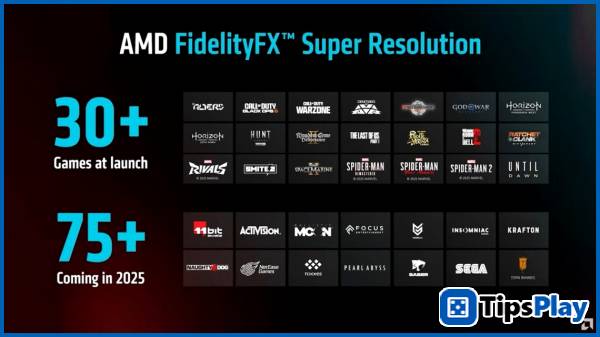
Currently, AMD FSR 4 only supports over 40 games at launch; other titles will be supported in subsequent updates.
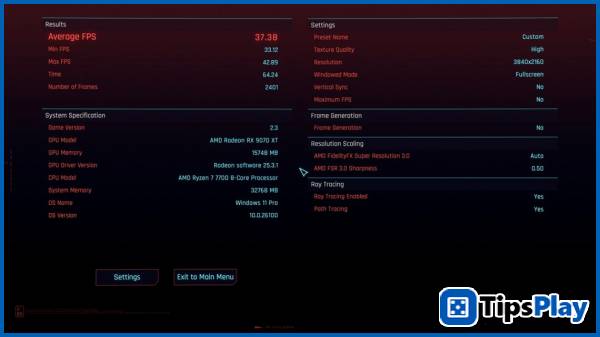
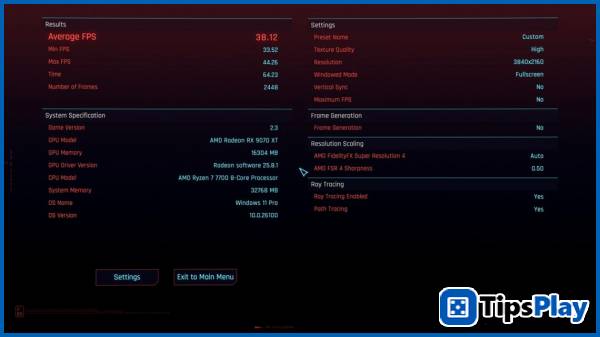
Test configuration:
- CPU: AMD Ryzen 7 7700
- VGA : AMD RX 9070 XT
- Memory : G.SKILL Trident Z DDR5 2x16GB 6000
- SSD: Samsung 980 Pro 1TB
Preliminary testing shows that AMD FSR 4 is capable of handling higher image quality than its predecessor, FSR 3.1, and there is no noticeable difference compared to AMD's DLSS 4.
As for rendering speed, AMD FSR 4 shows a certain difference compared to FSR 3.1 depending on the specific game; some games experience a small drop in frame rate, while others receive a small increase in speed.
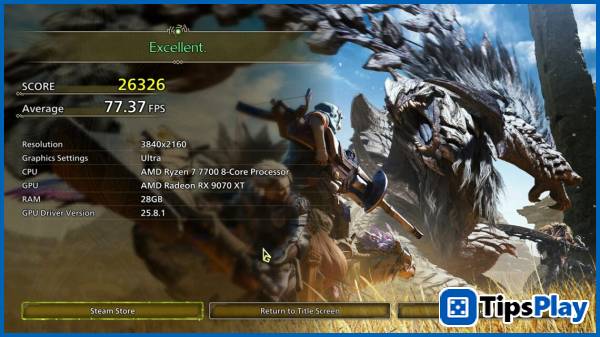
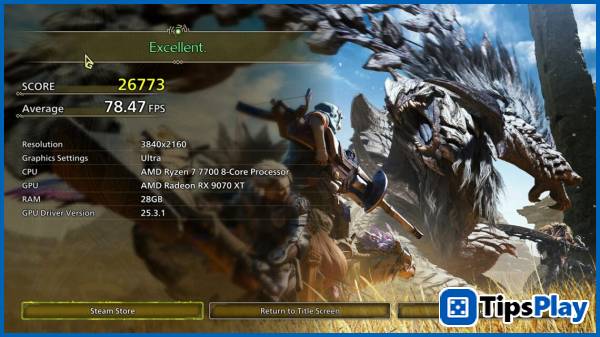
For example, with the game Monster Hunter Wilds at 4K resolution and the highest settings, the FSR 3.1 achieved a frame rate of 78.47fps, while the FSR 4 lagged slightly behind at 77.37fps.
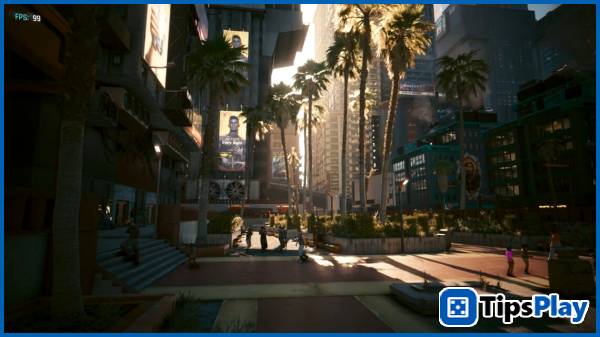
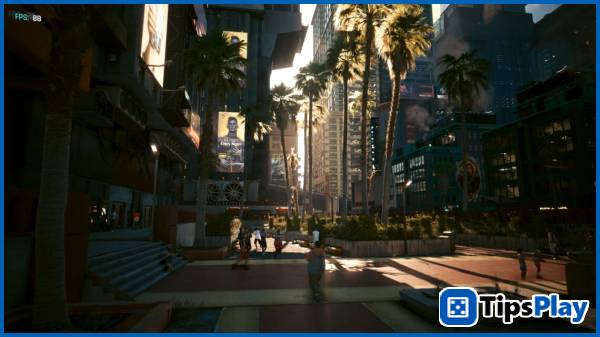
Meanwhile, in the game Cyberpunk 2077 at similar settings, the FSR 4 achieved a frame rate of 38.12fps, while the FSR 3.1 only reached 37.38fps.
Of course, FSR 4.0 still has some limitations. Support for new hardware means it's not yet accessible to the large number of gamers using older GPUs. Additionally, the number of games integrating FSR 4.0 is still quite small compared to FSR 3.1 – which became popular thanks to the expanded SDK. However, with AMD announcing plugins for Unreal Engine 5 and tools like OptiScaler supporting conversion, FSR 4.0 promises to quickly gain popularity.
Conclusion
Overall, AMD FSR 4 is an improvement over FSR 3.1. AI technology enhances the visual experience while offering convenience in updates and the ability to leverage the power of next-generation GPUs. While it may not completely replace FSR 3.1 in terms of widespread adoption, AMD FSR 4 has clearly defined AMD's future direction: artificial intelligence will be the key to enhancing the gaming experience in the future.
tipsplay.net will bring you the latest news in the coming time.
Update 19 March 2026
Kareem Winters
Kareem Winters is an AI integration expert, a strategic process of embedding artificial intelligence technologies—such as machine learning (ML), natural language processing (NLP), and computer vision—directly into an organization's existing systems, applications, and workflows.