Pearl Abyss employees reveal the original storyline of Crimson Desert and the company's work culture!
Recently, an employee at Pearl Abyss revealed the original storyline of Crimson Desert , as well as sharing more about the company's work culture.
Regarding the source, the article was shared on the gaming industry information section of Blind – a website where individuals in the technology field anonymously 'leak' important information.
For those who don't know, to post on Blind, you first have to provide your company email address and wait for the website to verify your identity. Therefore, the likelihood of someone impersonating an employee at Pearl Abyss is extremely low given this verification process.
Regarding the content of the article, the staff member stated that the original storyline of Crimson Desert was vastly different from the current version. Specifically, the original idea was more heavily focused on the political aspects of the world, revolving around a young king being usurped from his throne and having to seek the help of the Greymane mercenary group.
In addition, a middle-aged prime minister and a young princess also accompanied them to seek the help of the mercenaries, promising them nobility if they completed the mission.
Ultimately, the main objective throughout the game will revolve around reclaiming a 'currency' created from materials found only in the Crimson Desert .
Therefore, reclaiming this desert region would give the Greymane gang immense control and potentially elevate them to the aristocratic class. Furthermore, the middle-aged vizier will betray the Greymane gang to seize the throne, and the player's task will be to thwart his plan.

'If the title is Crimson Desert, then things related to it should appear, but in the storyline, they are completely absent.'
Do you know why?
That's because the storyline is only decided right before release.
Therefore, they couldn't release a storyline trailer, and since this was originally a story about a group of mercenaries, of course that group of mercenaries has now been sidelined.
The fact that the plot revolves solely around the main character, Kliff, is also due to this reason.
Furthermore, Kliff was originally named 'Macbeth', but the name was changed because it sounded a bit like the name of a serial killer…?
In terms of plot, it initially begins with a young king, dethroned, seeking the help of a group of Greymane mercenaries. A middle-aged vizier (?) and a young princess also accompany him, promising to grant them nobility.
The plot revolves around reclaiming a type of 'currency' crafted from minerals that can only be collected in the ' Crimson Desert ' region. Therefore, the conquest of the red desert is about gaining supremacy and elevating them to nobility.
This middle-aged vizier is believed to betray them and attempt to seize the throne for himself, and the story revolves around preventing that and achieving victory.

Regarding the reason for this significant change, an anonymous employee stated that the original director had left the company and been replaced by someone new. Immediately after taking the position, the new director quickly reversed all of the previous director's decisions.
'Amidst this, a director was ousted from his position in a power struggle and forced to resign. As soon as a new person, from the arts world, took over as General Manager, they started to turn things upside down. This General Manager was essentially just a figurehead; they were merely an obedient subordinate.'
Anyone in a managerial position is simply an obedient subordinate. Personal will? Independent opinion? Those things simply don't exist. That's why they're able to hold onto their positions.
As a result, everything started to be completely turned upside down to serve the artistic aspect. Even the character Ervin – who was originally the bodyguard of the 'young king' – was initially designed as a man.
When Zelda: Tears of the Kingdom was first released, they hastily followed the trend and created a completely illogical floating island in the sky. They referenced and incorporated features from various other games, but failed to understand why those features were included in the original titles.
For them, these features exist merely as a means to an end, serving some superficial purpose.
Finally, this employee also shared a few more words about the work culture at Pearl Abyss, as well as how other employees view products in the gaming market.
"Whenever they see something that looks cool, they just throw it in. After they've finished implementing it, they gather together and applaud themselves. I don't know what to call this behavior other than 'frog in a well'."
They are always criticizing and badmouthing Unreal Engine. When new games are released, they don't bother trying them out; they just watch them on YouTube and then continue to criticize those games.
They even loudly declared that God of War is just "garbage," only good for its visuals. As a God of War fan, I could only sigh in exasperation when I heard them comment that it's just a game with beautiful graphics but they don't understand even 1% of the depth of Kratos's story.
Anyway, as someone who was involved in the development of this game, I had hoped it would be a success; however, I am deeply saddened to see such a disastrous outcome.
I'm saddened because I feel like this game could have left a memorable mark on the gaming world in many different ways.
However, on the other hand, I felt relieved to receive clear confirmation that a great, high-quality game could never have originated from such a terrible work culture.
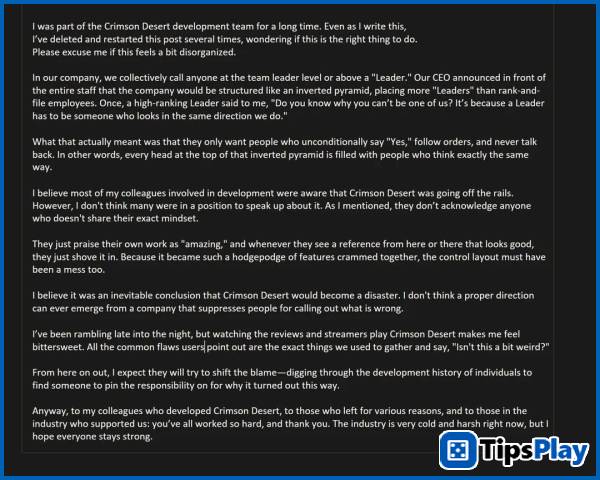
Notably, shortly after this post was published, another anonymous employee posted to reveal more information about the company's work culture.
'I was a member of the Crimson Desert development team for a long time. Even as I'm writing this, I've deleted and rewritten this post several times, wondering if it was really the right thing to do. Please forgive me if this post seems a bit messy and incoherent.'
At our company, anyone holding a position from team leader upwards is generally referred to as a 'Leader'. Our CEO once announced to all employees that the company's organizational structure would be built on an 'inverted pyramid' model – meaning the number of 'Leaders' would be much larger than the number of regular employees.
I once heard a senior leader say to me, "Do you know why you can't be one of us? It's because a leader must share our vision and direction." The real meaning behind that statement was that they only wanted to recruit people who were unconditionally obedient, followed orders, and absolutely never dared to question or argue.
In other words, every top position in that inverted pyramid is filled with people who share the same stereotypical mindset. I believe most of my colleagues involved in the game's development were well aware that the Crimson Desert project was spiraling out of control. However, I don't think many were brave enough or in the right position to speak out about it. As I mentioned, they simply wouldn't accept or respect anyone who didn't share the same mindset and perspective. They only knew how to praise their own product as 'great,' and whenever they came across a seemingly good idea from outside, they would shove it into the game.
Because the product had become a chaotic mess, with countless features haphazardly crammed in, it's perfectly understandable that the game's control system was convoluted and disorganized. I believe that Crimson Desert becoming a disaster was an inevitable and unavoidable outcome. I don't believe that a proper and standardized path could emerge from a company that suppresses and retaliates against employees who dare to point out existing flaws.
I stayed up late writing, but watching user reviews and streamers try out Crimson Desert left me with mixed feelings. All the flaws players are pointing out now are the very same issues we previously discussed and wondered about: 'Doesn't this seem a bit strange and illogical?'
From this point onward, I suspect they will try to shift blame – by digging through the work history of each individual on the development team to find a 'scapegoat,' someone to blame for why the product is so disastrous today.
Anyway, to the colleagues who developed Crimson Desert , to those who left for various reasons, and to everyone in the industry who supported us: everyone worked incredibly hard, and our sincerest thanks.
The gaming industry is incredibly cold and harsh right now, but I hope everyone will stay strong.

Update 23 March 2026
Micah Soto
Micah Soto is a creator of systematic processes encompassing the design, creation, testing, and maintenance of computer programs and applications. He transforms an idea or a set of user requirements into a functional software product that solves problems, automates tasks, or provides entertainment.