A bio-supercomputer powered by human brain cells is about to get its own data center.
Each CL1 device comes with a hefty price tag, around $35,000 (nearly 900 million VND). However, considering its energy efficiency and adaptive AI processing capabilities, it's seen as a groundbreaking investment for the future.
While giants like Google and Microsoft are grappling with the enormous power consumption of AI, an Australian startup called Cortical Labs has come up with a groundbreaking solution: using human brain cells to process data. According to Bloomberg, the company has partnered with DayOne to establish the first two bio-computing data centers in Australia and Singapore.

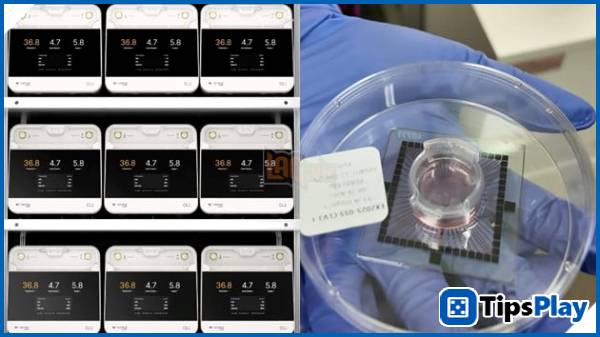
Hybrid silicon chip containing 200,000 human neurons.
At the heart of this system is a device called CL1. Unlike NVIDIA's pure silicon chips, CL1 is a hybrid system: a silicon chip integrated with 200,000 living human neurons. These cells, cultured in a laboratory from blood cells, are capable of responding to electrical stimuli and forming neural networks identical to those in our brains.
To keep these "mini-brains" alive, CL1 is equipped with a biosupport system that helps the cells survive and function stably for up to 6 months. Previously, Cortical Labs caused a sensation when it demonstrated that CL1 could learn to play legendary games like Pong and even DOOM.
It consumes less electricity than even. a handheld computer.
CL1's absolute advantage lies in its energy efficiency. According to CEO Hon Weng Chong, while traditional AI chips consume hundreds of watts of power and generate enormous amounts of heat, CL1's neural network requires only a fraction of the energy, even less than a pocket calculator.
This is the "key" to solving the energy thirst of today's AI data center industry — which is resorting to extreme solutions such as building data stations inside wind turbines or underwater to dissipate heat.
Ambition to "cover" Singapore and Australia
According to the cooperation agreement:
-
In Melbourne (Australia): One facility will operate with 120 CL1 devices.
-
In Singapore: The project is on a much larger scale, aiming to install 1,000 devices. In the initial phase, 20 CL1 machines will be tested at the Yong Loo Lin School of Medicine (National University of Singapore).
Each CL1 device comes with a hefty price tag, around $35,000 (nearly 900 million VND). However, considering its energy efficiency and adaptive AI processing capabilities, it's seen as a groundbreaking investment for the future.
Bringing biological computing from the lab to the real-world data center marks the official beginning of the era of "Biological Computing." Are we getting closer to a scenario like The Matrix, where biology and digital technology merge? We'll have to wait and see what Cortical Labs has to say.
Update 26 March 2026
Marvin Fry
Marvin Fry is a game analyst who serves as a crucial link between data and game design, using in-game metrics and player behavior data to improve game quality, engagement, and monetization.