72 GB of server RAM worth tens of thousands of USD were 'discarded' and thrown away.
It's worth noting that at the time they were phased out, the value of these RAM modules was much lower.
A seemingly ordinary story in the corporate IT environment is attracting significant attention online: dozens of server RAM modules were discarded after a system upgrade, but in reality, they are worth tens of thousands of dollars at current market prices.
From 'discarded' hardware to a high-value asset.
The story begins in 2024, when a company upgraded its server infrastructure. The new systems were equipped with larger memory capacities, rendering 72 old DDR4 RAM modules redundant. Following standard procedure, these components were typically separated for disposal or destruction.
However, before it could be discarded, an employee kept all of the RAM and later gave it to a relative. The story was shared online and quickly gained attention when the actual value of the components was revealed.
Currently, SK hynix's DDR4 server RAM modules (Registered DIMM type) are selling for nearly $288 per stick. If you calculate the total, 72 sticks could be worth over $20,000 – a considerable sum.
Why do businesses still discard perfectly good hardware?
It's worth noting that at the time of their discontinuation, the value of these RAM modules was significantly lower. Market data shows that in 2024, each module was only worth around $30–35, and could even drop below $30 by mid-2025.
The subsequent sharp price increase was primarily driven by a global DRAM shortage, as demand from AI data centers surged. This caused many components previously considered obsolete to regain their value.
However, in a business environment, the actual value of hardware is often no longer considered after depreciation has been completed. On the accounting books, it's almost zero. At the same time, inspecting, storing, or reusing old components often incurs additional labor costs, leading businesses to choose disposal to optimize operations.
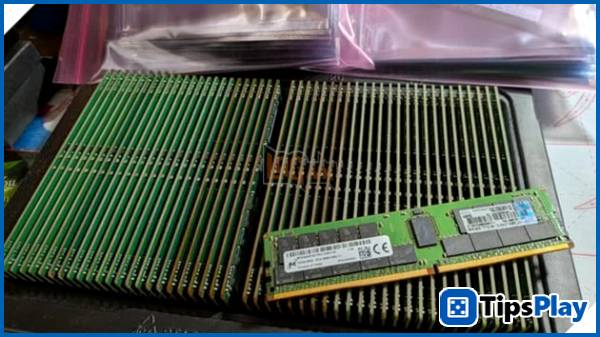
Not everyone gets to take advantage of this 'treasure'.
Despite its high value, the aforementioned amount of RAM is not easily usable by the average user. This is Registered DIMM memory, designed for server systems requiring high stability and support for features such as ECC (error correction).
Standard desktop motherboards will not recognize this type of RAM. To use it, users need a specialized platform such as an Intel Xeon or AMD EPYC CPU – which are not common in personal PC systems.
Therefore, the most viable option with such components is often to resell them to those building 'homelabs', small data centers, or businesses still using legacy infrastructure.
Lessons from the Enterprise Hardware Lifecycle
This story clearly reflects a reality: in business, the hardware lifecycle doesn't depend solely on performance, but is also influenced by upgrade cycles, budgets, and operational strategies.
Many components are still in good working order but become redundant simply because they are no longer compatible with the new system. As a result, they are discarded or become electronic waste, even though their actual value may have changed significantly depending on the market.
In the context of increased hardware demand driven by AI, such cases are likely to become more common – and sometimes, the 'junk pile' can be a missed opportunity.
Update 21 April 2026
Micah Soto
Micah Soto is a creator of systematic processes encompassing the design, creation, testing, and maintenance of computer programs and applications. He transforms an idea or a set of user requirements into a functional software product that solves problems, automates tasks, or provides entertainment.